How Renewable Energy Is Changing Fastener Requirements
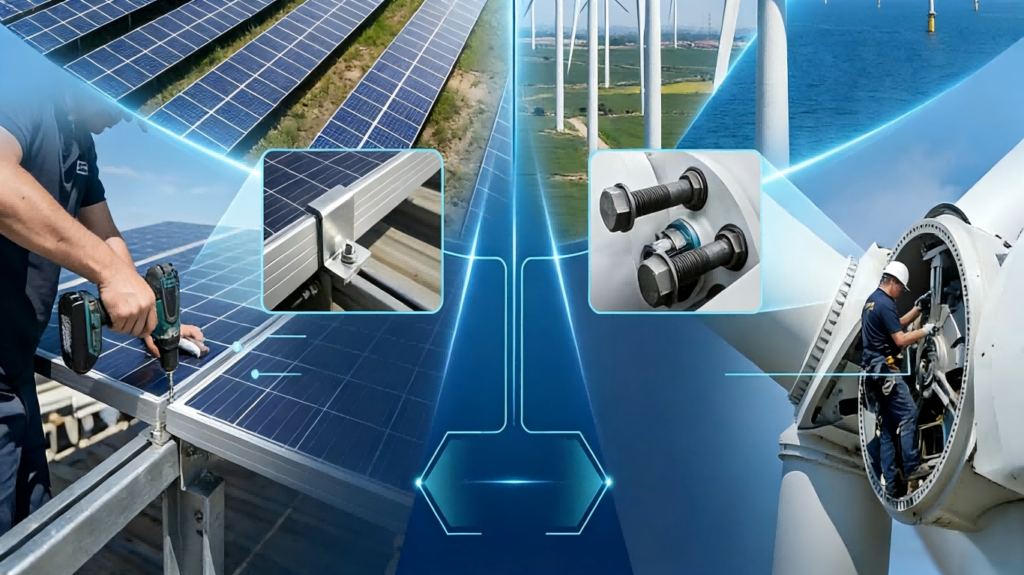
Wind and Solar Fasteners
The global shift toward sustainable power generation has fundamentally restructured the technical requirements and material science of the wind and solar fasteners industry. As we transition from centralized fossil fuel plants to expansive, decentralized wind and solar assets, the humble fastener has evolved from a simple commodity component into a mission-critical high-performance device.
1. Wind Turbine Fatigue: The Marine Engineering Challenge
Unlike traditional thermal power plants where the primary design threat is creep (deformation under heat), wind fasteners must primarily contend with fatigue and corrosion.
Preload Attenuation in Blade-Root Joints
Maintenance of bolt preload—the initial tension holding a joint together—is vital for wind turbine structural health. Research indicates that preload attenuation is a leading cause of bolt fatigue failure. For common M36 blade-root bolts, the preload decay rate can range from 11% to 16% due to the nonlinear behavior of the joint and the composite-metal interface.
- Expert Insight: To counter this, practitioners are moving toward structural bolts compliant with ASTM A490 or EN 14399, often utilizing fine particle peening to introduce compressive residual stresses that improve fatigue strength.
Corrosion-Fatigue Coupling
Offshore wind turbines face corrosion-fatigue coupling, where salt spray creates pits that act as stress concentrators. These pits allow cracks to initiate and propagate rapidly through the steel, effectively eliminating the “fatigue limit” found in inland structures.
2. Solar Fasteners Stability: Static vs. Dynamic Torsion
Solar fasteners installations require to endure 25-to-30-year lifespans in high-UV desert or high-humidity coastal environments.
- Fixed-Tilt Systems: Focus remains on pure tensile and shear strength to resist wind uplift and snow loads.
- Solar Trackers: These systems introduce dynamic challenges. The torque tube (the tracker’s backbone) must resist powerful rotational torque from wind. This necessitates high-strength fasteners (Property Class 10.9+) paired with anti-loosening solutions such as wedge-lock washers (e.g., Nord-Lock style) or nylon-insert lock nuts to manage continuous vibration.
3. Practical Material Selection
Environmental exposure is the primary driver of component failure in the field. Procurement should prioritize materials based on site-specific aggressive agents:
- 316L Stainless Steel: The industry baseline for offshore or coastal zones due to its molybdenum content, providing essential resistance to chloride pitting.
- Duplex Stainless Steels: Specified for extreme stress or chemical environments where the risk of Stress Corrosion Cracking (SCC) is high.
- Titanium Alloys: Increasingly used in nacelles for an unmatched strength-to-weight ratio and immunity to many environmental toxins.
4. The Digital Shift: Smart Fasteners & Predictive Maintenance
2025 marks the widespread adoption of Smart Fasteners integrated into the Internet of Things (IoT).
- Real-Time Monitoring: Embedded sensors now monitor load, stress, and vibration in real-time.
- Predict and Prevent: Instead of costly scheduled manual inspections—which can be hazardous on offshore assets—smart fasteners alert operators only when tension drops below safe levels, facilitating predictive maintenance and significantly reducing downtime.
Conclusion
Wind and solar fasteners may be the smallest part of the grid, but they carry the greatest responsibility. By prioritizing high-strength alloys, verified preload levels, and digital monitoring, professionals can ensure that the infrastructure of the global energy transition remains secure for decades.