Why Marine Environments Destroy Fasteners Faster Than You Expect
Marine Fastener Corrosion
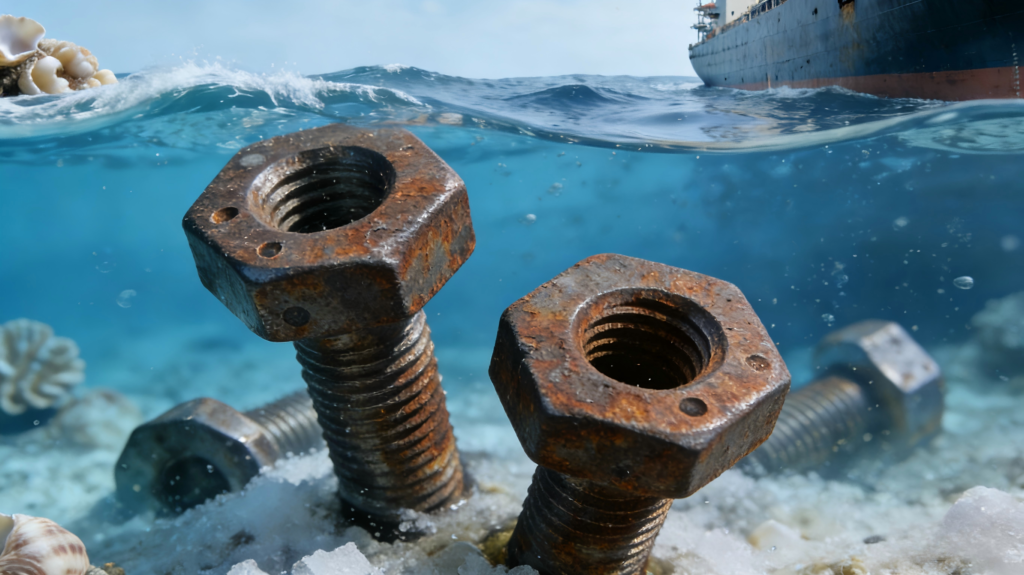
Fasteners used in marine and coastal environments often fail years earlier than design expectations. The primary cause is not overload — it is corrosion-driven cross-section loss and localized attack mechanisms that are underestimated during material selection.
Unlike general atmospheric corrosion, marine exposure introduces:
- High chloride concentration
- Continuous wet–dry cycles
- Oxygen-rich conditions
- Crevice-forming joint geometries
- Galvanic coupling risks
This article focuses on three critical mechanisms engineers and procurement teams must understand:
- Pitting corrosion
- Crevice corrosion
- Practical material selection strategies
1. Pitting Corrosion: Localized Attack That Causes Sudden Failure
What It Is
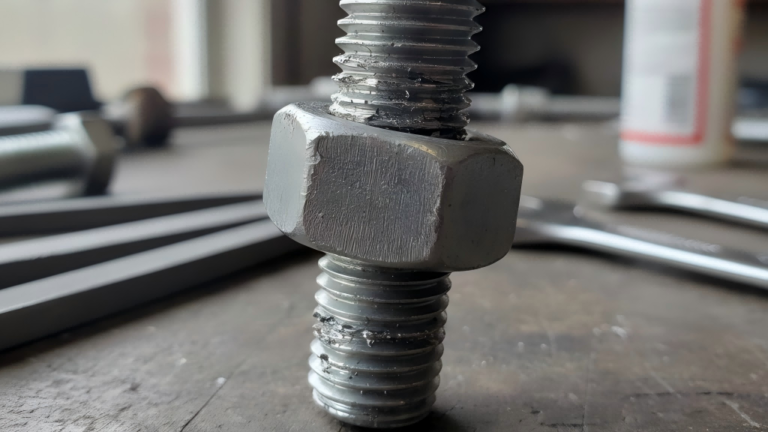
Pitting corrosion is a highly localized form of corrosion that penetrates the metal surface while leaving surrounding areas relatively intact.
In Marine Fastener Corrosion, chloride ions penetrate passive oxide layers (especially on stainless steels), initiating micro-anodic sites. Once formed, pits propagate autocatalytically:
- Local acidity increases
- Chloride concentration inside pit rises
- Oxygen depletion prevents repassivation
The result: rapid depth penetration with minimal visible warning.
Why It Is Dangerous for Fasteners
Fasteners are particularly vulnerable because:
- Stress is concentrated at thread roots
- Surface area-to-volume ratio is high
- Minor section loss dramatically reduces tensile capacity
A 0.5 mm deep pit at a thread root can reduce effective stress area significantly, accelerating fatigue crack initiation.
In high-strength fasteners (e.g., 8.8, 10.9, 12.9), pits frequently become crack initiation sites under cyclic loading.
Materials Most at Risk
- AISI 304 stainless steel in seawater exposure
- Low-alloy carbon steel with coating damage
- High-strength martensitic steels without cathodic protection
A common mistake is assuming “stainless” equals “marine resistant.”
In reality, 304 performs poorly in chloride-rich splash zones.
2. Crevice Corrosion: Hidden Failure Inside the Joint
Where It Occurs
Crevice corrosion develops in shielded areas where oxygen access is restricted:
- Under bolt heads
- Under washers
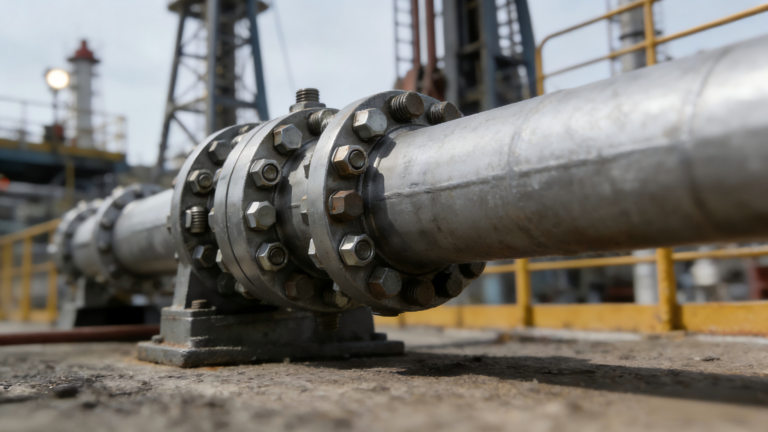
- Between flange faces
- Inside threaded connections
Marine structures create ideal crevice conditions due to salt deposition and retained moisture.
Mechanism
Inside the crevice:
- Oxygen depletion occurs.
- The region becomes anodic relative to external surfaces.
- Chlorides concentrate.
- Local pH drops.
- Rapid localized metal dissolution begins.
The external surface may appear intact while severe attack progresses under the head or inside threads.
This is one reason why Marine Fastener Corrosion during disassembly — threads are deeply degraded internally while the visible shank appears sound.
Why Crevice Corrosion Is More Dangerous Than Uniform Corrosion
Uniform corrosion reduces section gradually and predictably.
Crevice corrosion creates localized penetration that:
- Compromises preload retention
- Causes thread shear failure
- Accelerates fatigue crack growth
For bolted flange joints, this may lead to loss of clamping force long before visible rust suggests danger.
3. Material Selection Strategies for Marine Fastener Corrosion
Material selection must be based on:
- Chloride exposure level (atmospheric vs splash zone vs immersion)
- Structural criticality
- Required mechanical strength
- Maintenance accessibility
- Expected design life
Below are practical guidelines used in marine engineering.
3.1 Carbon Steel with Coatings
Suitable For:
- Above-deck, non-critical structures
- Replaceable components
- Temporary installations
Typical Options:
- Hot-dip galvanizing
- Zinc-aluminum flake coatings
- Thermal spray aluminum
Limitations:
- Coating damage during installation
- Accelerated degradation in splash zones
- Crevice attack at coating holidays
Coating thickness alone does not solve crevice corrosion.
3.2 Austenitic Stainless Steel
304 (A2)
Not recommended for true Marine Fastener Corrosion.
Acceptable only for:
- Indoor coastal facilities
- Light atmospheric exposure
316 (A4)
Improved molybdenum content increases pitting resistance.
Suitable for:
- Coastal infrastructure
- Mild splash exposure
- Non-immersed marine applications
However, 316 still fails in:
- Continuous immersion
- High-temperature seawater
- Oxygen-depleted crevices
3.3 Duplex Stainless Steel (e.g., 2205)
Recommended for:
- Offshore platforms
- Shipbuilding
- Coastal bridges
- High-load marine structures
Advantages:
- Higher pitting resistance equivalent number (PREN)
- Better strength-to-weight ratio
- Improved crevice corrosion resistance
- Reduced need for oversizing
Duplex fasteners often allow downsizing due to higher yield strength while maintaining corrosion resistance.
3.4 Super Duplex & Nickel Alloys
For:
- Seawater immersion
- Subsea applications
- High-chloride industrial marine environments
Cost is significantly higher, but lifecycle cost is lower for critical systems.
Additional Engineering Considerations
Material selection alone is not sufficient.
Engineers should also evaluate:
- Galvanic compatibility with connected materials
- Surface finish (rough surfaces initiate corrosion faster)
- Thread lubrication to prevent galling in stainless assemblies
- Drainage design to avoid stagnant water retention
- Cathodic protection interaction
Ignoring joint design details often negates material upgrades.
Marine fastener corrosion selection is a lifecycle cost decision, not a unit-price decision.
Marine environments destroy fasteners faster than expected because localized corrosion mechanisms — especially pitting and crevice corrosion — are far more aggressive than uniform atmospheric corrosion.
To ensure durability:
- Understand chloride-driven electrochemistry
- Avoid 304 in real marine exposure
- Consider duplex grades for critical structures
- Design joints to minimize crevice formation
- Align procurement decisions with exposure classification
The cost of premature fastener failure in marine structures far exceeds the initial material upgrade.