Critical Heat Treatment in High-Strength Fasteners:
Technical Impact on Strength, Toughness, and Failure Risk
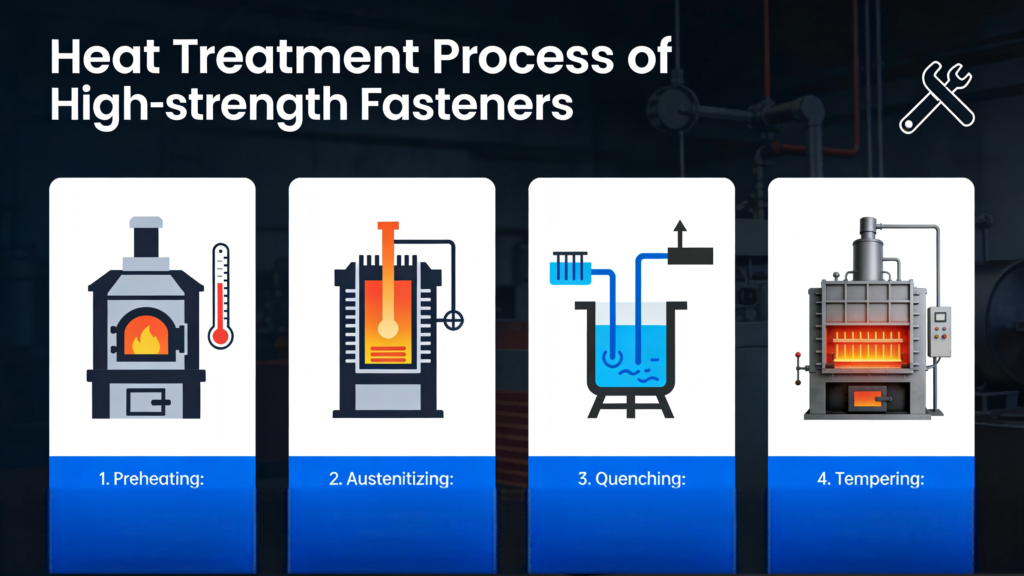
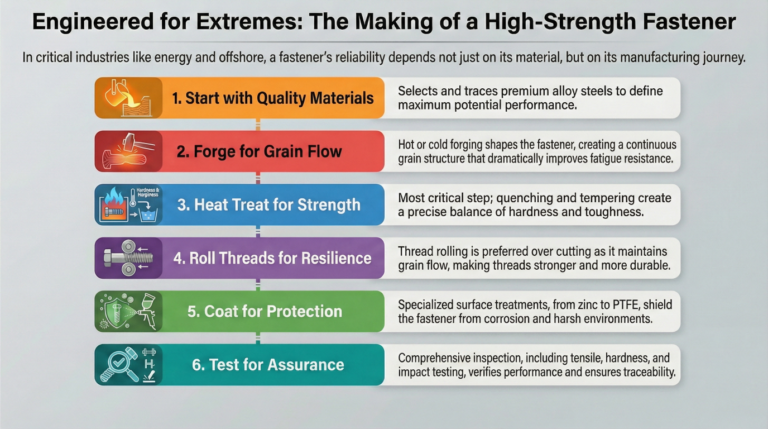
Heat treatment in high-strength fasteners is the single most decisive process step determining whether a bolt performs reliably or becomes a latent failure risk.
From a manufacturing perspective, heat treatment is not simply about achieving a specified hardness range. It directly controls microstructure, residual stress distribution, toughness, fatigue resistance, and susceptibility to failure mechanisms such as brittle fracture, hydrogen embrittlement, and stress corrosion cracking.
This article provides a practical, engineering-focused analysis of how heat treatment affects high-strength fastener performance, based on real manufacturing and field experience.
Role of Heat Treatment in High-Strength Fasteners
Most carbon steel and alloy steel high-strength fasteners rely on a quench-and-temper process to achieve their final mechanical properties.
The objectives of heat treatment are:
- Transform the steel microstructure into martensite through controlled quenching
- Relieve excessive internal stresses via tempering
- Achieve a balance between tensile strength and impact toughness
- Ensure property uniformity from head to shank to thread
Any deviation from these objectives increases failure probability under service conditions.
Austenitizing: Foundation of Microstructure Control
Austenitizing temperature and holding time determine grain size and carbon solution.
Key technical considerations:
- Undershooting temperature may result in incomplete austenitization, leading to mixed microstructures and inconsistent hardness
- Overshooting temperature promotes grain coarsening, which reduces toughness and fatigue resistance
- Large-diameter fasteners require longer soak times to ensure core temperature uniformity
Inadequate control at this stage often leads to head-to-core property variation, especially in heavy-section fasteners.
Quenching: Strength vs Residual Stress Trade-Off
Quenching transforms austenite into martensite and defines the upper limit of strength.
Practical risks during quenching:
- Excessive quench severity increases residual stress and cracking risk
- Insufficient quenching leads to retained austenite and reduced strength
- Geometry-driven cooling rate differences can cause distortion and hardness gradients
For high-strength bolts, quench media selection (oil, polymer, or controlled gas) must be matched to fastener size, alloy composition, and target strength class.
Tempering: The Most Underestimated Step
Tempering is often treated as a secondary operation, but in practice it defines service reliability.
Effects of proper tempering:
- Reduces quench-induced residual stresses
- Improves impact toughness and ductility
- Stabilizes microstructure for long-term service
Common tempering-related failures:
- Under-tempering: excessive hardness, brittle fracture, hydrogen embrittlement sensitivity
- Over-tempering: strength loss and preload relaxation
For low-temperature or dynamic load applications, tempering parameters should prioritize toughness rather than maximum strength.
Heat Treatment Uniformity in Threads and Under-Head Areas
Fastener failures frequently initiate at threads or under-head fillet radii.
Key manufacturing controls include:
- Ensuring uniform heating of rolled threads
- Avoiding decarburization or carburization during furnace exposure
- Verifying hardness at multiple locations, not only mid-shank
Localized hardness variation is a common root cause of unexpected fatigue or brittle failures.
Heat Treatment and Failure Mechanisms
Improper heat treatment directly increases susceptibility to several critical failure modes:
- Low-temperature brittle fracture due to insufficient toughness
- Hydrogen embrittlement when hardness exceeds safe limits
- Accelerated stress corrosion cracking in high-strength stainless or alloy steels
In many field investigations, these failures are incorrectly attributed to material grade rather than heat treatment quality.
Verification and Quality Control: What Actually Matters
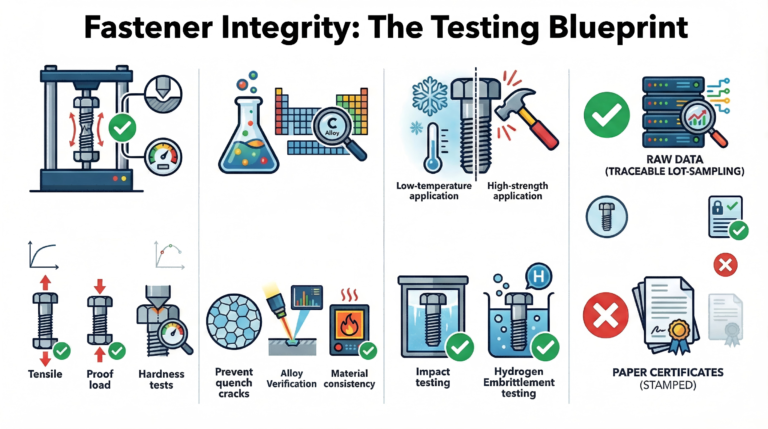
Effective heat treatment control requires more than hardness testing.
Recommended verification methods include:
- Hardness mapping along head, shank, and thread
- Charpy impact testing when service temperature is critical
- Microstructure examination for martensite uniformity and grain size
- Traceability of heat treatment batch and furnace parameters
For critical projects, heat treatment process qualification should be reviewed with the fastener manufacturer.
Practical Guidance for Engineers and Buyers
From a practical standpoint:
- Avoid specifying the highest possible strength unless technically justified
- Match heat treatment parameters to service environment, not catalog values
- Evaluate manufacturer heat treatment capability, not only certificates
Fastener reliability is defined long before installation — it is established during heat treatment.
Conclusion
Heat treatment is not a routine manufacturing step; it is a risk-defining process for high-strength fasteners.
A well-designed heat treatment process delivers predictable strength, adequate toughness, and long-term reliability. Poor control creates fasteners that meet specifications on paper but fail in service.
For critical applications, understanding and controlling heat treatment is essential to preventing costly and dangerous fastener failures.