
Industrial Fasteners: The Critical Connection
Industrial Fasteners
In the complex world of modern infrastructure and heavy industry, the reliability of an entire system often rests on its smallest components: the industrial fasteners. Ranging from high-strength bolts and nuts to specialized rivets and studs—act as the critical connection that ensures structural integrity and operational safety in the world’s most demanding environments.
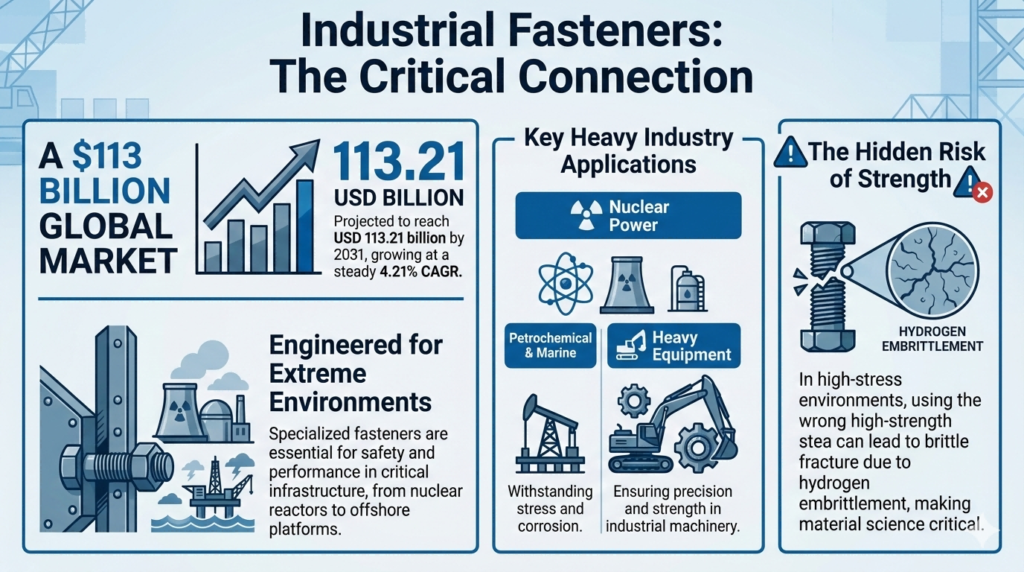
As we look toward 2031, the global industrial fastener market is projected to grow from USD 88.38 billion in 2025 to USD 113.21 billion, driven by manufacturing automation, heavy-machinery upgrades, and precision-assembly requirements. While industrial fasteners are ubiquitous, their most vital roles are found in the backbone of our global economy: energy, nuclear power, and heavy equipment.
1. Nuclear Power: Safety Without Compromise
In nuclear power facilities, industrial fasteners must meet the most stringent safety and quality standards in existence. Because the consequences of failure are catastrophic, these components are essential for securing reactor vessels, pressure vessel heads, and cooling system infrastructure.
- Material Excellence: Stainless steel and high-strength alloys are preferred for their resistance to radiation and moisture-induced degradation.
- Precision Maintenance: Critical fasteners in reactor components undergo non-destructive testing (NDT), such as ultrasonic inspections, to detect hidden stress or deformation before a failure can occur.
- Leak-Free Integrity: Stud bolts are utilized extensively in piping systems to ensure leak-free flange connections under the extreme heat and pressure typical of nuclear operations.
2. Petrochemical and LNG: Resisting the Elements
The energy sector, particularly Liquefied Natural Gas (LNG) and oil and gas processing, requires fasteners that can survive harsh environmental conditions, including extreme temperatures and highly corrosive atmospheres.
- Corrosion Resistance: Specialty materials like Zeron 100 super duplex stainless steel are often employed because they offer superior resistance to chloride pitting and stress corrosion cracking compared to standard series steels.
- Cryogenic Applications: In LNG facilities, industrial fasteners are crucial for securing storage tanks and cryogenic insulation, maintaining the extreme low temperatures required to keep natural gas in its liquid state.
- Infrastructure Reliability: High-strength bolts are the primary choice for securing high-pressure pipelines and wind turbine components, supporting the global transition to modernized energy infrastructure.
3. Marine and Heavy Equipment: Precision at Scale
The heavy equipment and marine industries rely on large-scale industrial fasteners that provide immense tensile strength and durability under constant mechanical stress.
- Heavy Modernization: Large-diameter fasteners (exceeding M36) are increasingly in demand for shipyards, mining equipment, and high-capacity industrial presses.
- Marine Durability: Fasteners used in ship hulls and offshore loading systems must withstand constant exposure to saltwater and high-load dynamic forces.
- Automation Growth: As precision becomes paramount, the industrial machinery and robotics segment is expected to be the fastest-growing application area, with micro-fasteners becoming essential for automated systems and robot joints.
4. Industry 4.0: The Rise of Smart Fastening
The “Critical Connection” is becoming increasingly intelligent. With the implementation of Industry 4.0, industrial fasteners are evolving from passive hardware into active monitoring systems.
- Smart Bolts: New sensor-enabled fasteners can continuously monitor preload and tension. These “smart bolts” alert operators via cloud dashboards when tension drops, allowing for predictive maintenance and reducing unplanned downtime in systems like wind turbine gearboxes.
- Digital Traceability: Modern industrial plants are demanding fasteners with integrated data tracking to ensure total traceability and quality control throughout the global supply chain.
5. Managing Technical Challenges: The Risk of Embrittlement
While high-strength fasteners are essential for heavy industry, the principle of “stronger is better” is not always true. High-strength steels (property classes 10.9 and 12.9) are susceptible to Hydrogen Embrittlement (HE) and Stress Corrosion Cracking (SCC).
To mitigate these risks, industry leaders focus on:
- Advanced Coatings: Moving away from traditional electroplating toward zinc flake coatings to reduce hydrogen exposure during manufacturing.
- Strategic Baking: Implementing strict heat treatment (baking) processes within four hours of plating to remove atomic hydrogen before it can damage the material structure.
Conclusion
From the depths of subsea oil rigs to the core of nuclear reactors, industrial fasteners provide the essential strength that holds our world together. As the global market expands, the focus remains on material innovation, digital integration, and unwavering safety standards. By understanding the unique demands of each industry, we ensure that every connection—no matter how small—remains a strong and secure one.
Related Documents: Fortune Business Insights,Mordor Intelligence,OpenPR
Find Our Products: Products